Plenty of shops that don’t accept Blue Light Card still turn up in discount lists, and the reason is that “no discount at the till gets confused with no offer at all. They are not the same thing.
Some names on this page genuinely give members nothing. Others give nothing at the checkout but sell a discounted Shopping Card instead, which is the same mechanic behind most of the supermarket savings on the card.
Blue Light Card publishes pages for brands it has no deal with, headed “discount code alternative”. If you land on one of those, that is the answer. There is no code.
- Amazon, Zara, Lidl and Home Bargains give Blue Light Card holders nothing, by any route.
- Primark and John Lewis refuse the card at the till but sell discounted Shopping Cards.
- Aldi takes the card as proof of who you are, not as a discount.
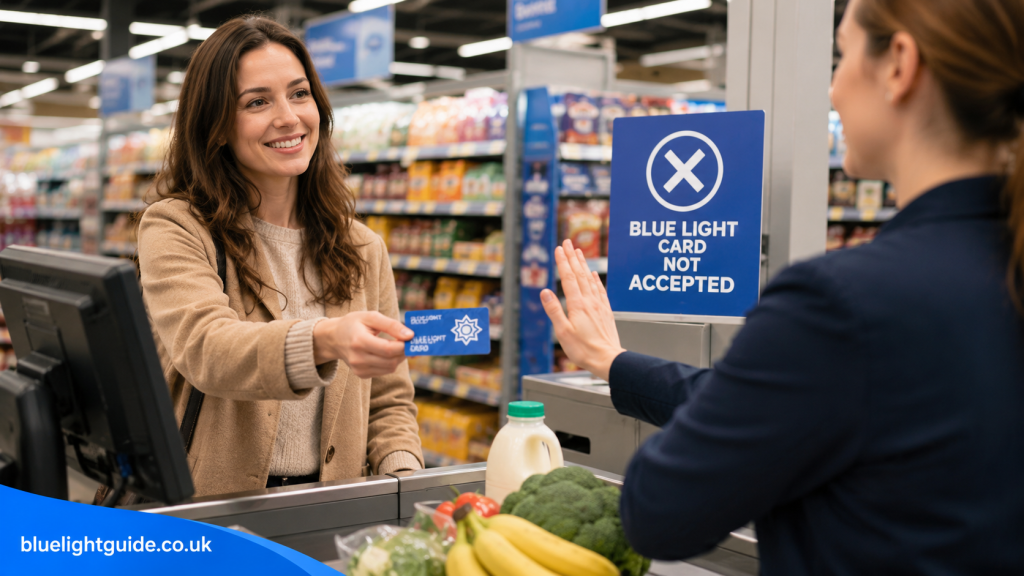
Shops That Do Not Accept Blue Light Card
These are the names people search for most, what each one really gives, and what to do instead.
| Retailer | Accepts the card? | Where to go instead |
|---|---|---|
| Amazon | No, and never has | Currys or Argos for the same tech |
| Aldi | No money off | Morrisons or Iceland |
| Lidl | No | Morrisons or Iceland |
| Primark | Not at the till | Buy the card first, then shop |
| John Lewis | Not at the till | Buy the card first, then shop |
| Zara | No | H&M or New Look |
| LEGO | No direct offer | Argos, John Lewis, The Entertainer |
| Home Bargains | No | B&M, which does have a Shopping Card |
Does Amazon Accept Blue Light Card
Amazon has no Blue Light Card partnership, and there has never been one to lose.
The clearest proof comes from Blue Light Card itself. Its Amazon page is headed as a discount code alternative, which is a polite way of saying there is no Amazon code and there never was.
Ignore any site offering you an Amazon Blue Light code. Those pages exist to catch the search, and the codes on them do not work.
Amazon runs no staff or key worker scheme of any kind in the UK. Prime, Warehouse deals and Lightning Deals are open to everybody, so nothing is being withheld from you specifically.
For anything you would have bought on Amazon, the card does better at Currys and Argos, and a cashback site usually beats the difference on smaller orders.
Aldi and Lidl
Neither takes a penny off your shop, but Aldi does something with the card that Lidl does not.
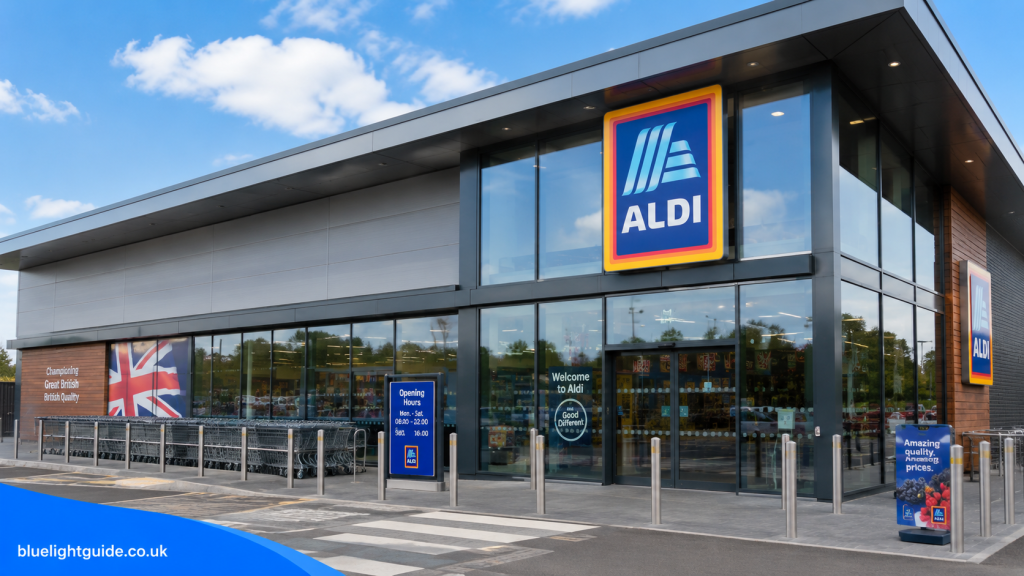
Aldi accepts a Blue Light Card as proof of eligible employment for its priority shopping arrangements. That is a store access perk and nothing more, so do not expect anything at the checkout.
Lidl has no arrangement at all. Lidl Plus coupons and scratchcards get quoted as a Blue Light perk fairly often, and they are not one, because the app is free for anyone to download.
Neither discounter needs the card to be cheap, which is rather the point of them. Save the card for the big four, where a 3% to 5% Shopping Card actually moves the bill.
Primark
Show your card at a Primark till and you will get a blank look, but there is a real offer sitting behind it.
Primark sells a discounted Primark Shopping Card through Blue Light Card. You buy it below face value in the app, it lands in your account digitally, and you hand it over at the till like a gift card.
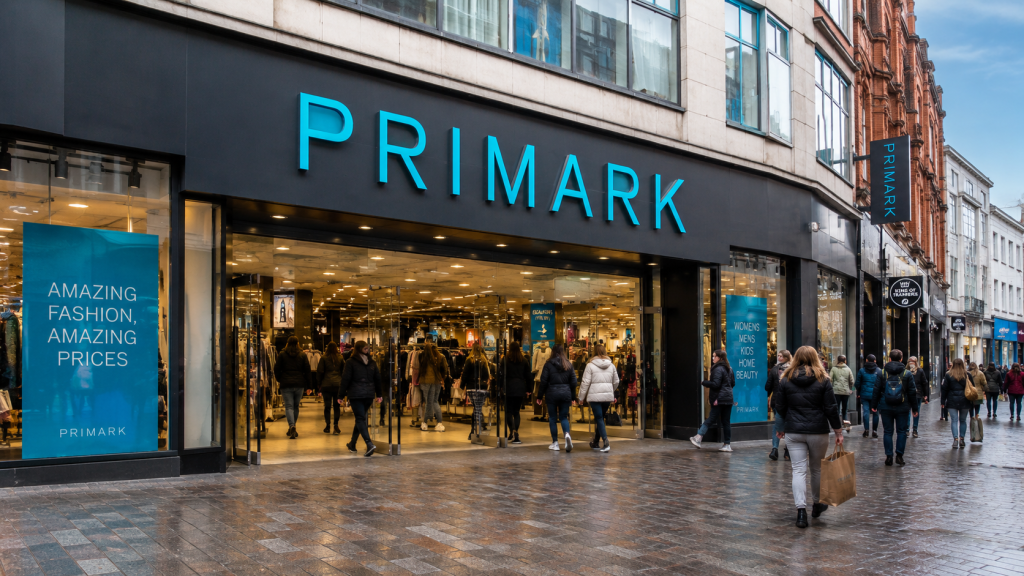
The catch is that Primark has no UK online shop, so the Shopping Card is in store only. Buy it in the car park if you have to, but buy it before you queue.
This is worth knowing before a school uniform run, which is the one Primark trip big enough for the percentage to matter.
John Lewis
Same story as Primark, except the John Lewis version works online too.
There is no member discount applied at a John Lewis checkout. The saving comes from a John Lewis Shopping Card bought below face value, spent either in store or by entering the card details at the payment stage on johnlewis.com.
Any leftover balance stays on the card, so you can load an odd amount without wasting it.
Because the discount is baked into the purchase price rather than applied at checkout, it does not clash with a John Lewis sale. That is the quiet advantage of the whole Shopping Card mechanic.
Zara, LEGO and Home Bargains
All three are dead ends, and only one of them offers a sensible way round it.
Zara runs no key worker scheme and barely issues promotional codes to anyone. Its twice-yearly sale is the only real saving, and everybody gets that.
LEGO is the interesting one. Blue Light Card states plainly on its own LEGO page that no direct code exists, then points members at partner retailers that stock it, which is a workaround worth taking before a birthday.
Home Bargains has nothing. B&M is the closest equivalent that does, through a Shopping Card at roughly 5%.
The Refusals Worth Working Around
John Lewis is the one I would bother with. It is the shop on this page where a single purchase is big enough that a few percent off a washing machine or a sofa is real money.
Primark only makes sense on a genuinely large trip. Loading a Shopping Card to save a few pence on a £12 basket is not a saving, it is a hobby.
Amazon, Zara, Lidl and Home Bargains are simply not Blue Light Card shops. Stop checking and spend the effort where the card does something, which is the list of partners that actually pay out.
Partnerships That Have Ended
Some of the confusion is not confusion at all. The deal existed, then it stopped, and the blog posts never got updated.
Asda is the big one. It ran a genuine in-store benefit through the Rewards Cashpot until it closed the partnership in May 2025, and half the money-saving web still quotes the old 5% terms as though nothing happened.
A dropped partnership almost always leaves a Shopping Card behind. That is what happened at Asda, and it is why the brand still appears in the app while giving nothing at the till.
The full picture on that one, including why linking your card in the Asda Rewards app no longer does anything, sits in the Asda breakdown.
Tesco belongs in the same bracket for different reasons. There has never been a till discount there either, only a Shopping Card at around 4%, which people keep discovering the hard way at the self-checkout.
How to Check a Shop Before You Go
Search the brand in the Blue Light Card app first, and read what type of offer comes back rather than just noting that something appeared.
A Shopping Card tile means buy first, shop second. A code tile means online only in most cases. No tile, or a page telling you about alternatives, means there is nothing there.
Never ask at the till on the strength of a blog post. Staff at a non-partner shop have no button to press, and the awkward pause is entirely avoidable.
It also helps to know which categories the card is thin in. Grocery discounters, fast fashion and marketplace sites are consistently poor, while days out, motoring and eating out carry the offers worth having.
Partnerships move both ways, and brands do occasionally join. Rates and participation change often enough that anything on this page is worth a ten second check in the app before you plan a trip around it.