A Blue Light Card for students is not a student card. It is a healthcare and emergency services card that a specific group of students happens to qualify for, and the distinction is why so many applications get rejected.
If you are on an NHS placement, you are almost certainly in. If you are simply enrolled at a university, no course and no student ID will get you through, whatever the wider eligibility rules might look like at first glance.
Blue Light Card will not accept a paper ID card. That single line is behind most student rejections, because a temporary paper placement badge is exactly what a lot of students are handed on day one.
- Student nurses, midwives and paramedics on NHS placement qualify at the usual £4.99 for two years.
- Your course enrolment proves nothing. Your placement does.
- An nhs.net email verifies you instantly and skips the document queue entirely.
Which Students Can Get a Blue Light Card
The test is not what you study. It is whether you can show an active link to an eligible employer.
| Course or role | Eligible? |
|---|---|
| Student nurse or midwife on placement | Yes |
| Student paramedic on placement | Yes |
| Ambulance or NHS apprentice | Yes, as an employee |
| Medical or dental student on clinical placement | Usually |
| Trainee social worker on placement | Usually |
| Student working in a pharmacy or opticians | Yes, as an employee |
| Any other university student | No |
Student Nurses and Midwives
The clearest yes on this page, provided you are actually out on placement rather than still in your first term of lectures.
The Royal College of Nursing’s own publication confirms the card is open to nursing students on NHS placement who can produce valid ID. That is the whole condition.
Apply under the NHS category and pick your placement trust, not your university. The application does not have a student option, and trying to force one is how people end up stuck.
If your trust has given you an nhs.net address, use it. Email verification is instant, while document review takes one to three working days and is where applications stall.
Student Paramedics and Ambulance Apprentices
Both get in, but by two different doors, and the apprentice route is the easier one.

An apprentice employed by an ambulance service is simply staff. You have a payslip and a proper ID badge, so you apply exactly as any employee would and nobody will query it.
A university student paramedic on placement has no payslip, which makes the trust ID badge the only thing standing between you and a rejection. Ask your placement team for the plastic one rather than a printed slip.
Medical, Dental and Allied Health Students
Usually accepted once clinical placements start, and usually refused before that point.
Medical students in preclinical years have no trust affiliation to evidence, which is the sticking point rather than any rule about medicine specifically. Physiotherapy, radiography, occupational therapy and pharmacy students sit in the same position.
Trainee social workers on a local authority placement are treated under the social care category instead, and a letter from the placement provider on headed paper does the job.
Working part time in a pharmacy or an opticians while you study makes you an employee of an eligible organisation in your own right. A payslip settles it, and your course becomes irrelevant.
Students Who Do Not Qualify
Being at university is not a qualifying condition, and no amount of supporting paperwork changes that.
Blue Light Card’s employment options run to employed, retired and volunteer. There is no student category, which tells you everything about how the scheme sees you.
Health and social care students on purely theoretical courses with no placement element are caught by this too, which feels unfair and is nonetheless the rule.
Nor does a family connection help. Living with an NHS parent, or being named on their household, does nothing for your own application because the card is issued to an individual.
If you are on a healthcare course but your placements start next year, you are not permanently excluded. You are early, and the application will work when the badge does.
Proof That Actually Gets Accepted
Blue Light Card verifies every member, and the requirement is ID clearly showing your name alongside your affiliation to an eligible employer.
Paper ID is rejected outright. The stated fallback is a payslip, which is exactly what a placement student does not have, and that gap is the single most common reason a student application fails.
A university enrolment letter carries no weight on its own either. It proves you are studying, and studying is not the thing being checked.
What works is anything issued by the trust rather than the university. Blue Light Card sets out the accepted formats on its eligible professions page, and every one of them traces back to an employer.
Apply in placement week, not freshers’ week. Your badge and your trust email both exist then, and neither of them exists in September.
Photograph the badge flat, in daylight, with your name and the trust name both legible in one shot. Cropped or angled images get bounced back and you rejoin the queue.
The rest of the process is the same as everyone else’s, and the step by step application walkthrough covers what happens after you upload.
Blue Light Card Compared With Student Discount Cards
The genuinely useful question is not which card to buy. It is which combination to hold, because most of them are free.
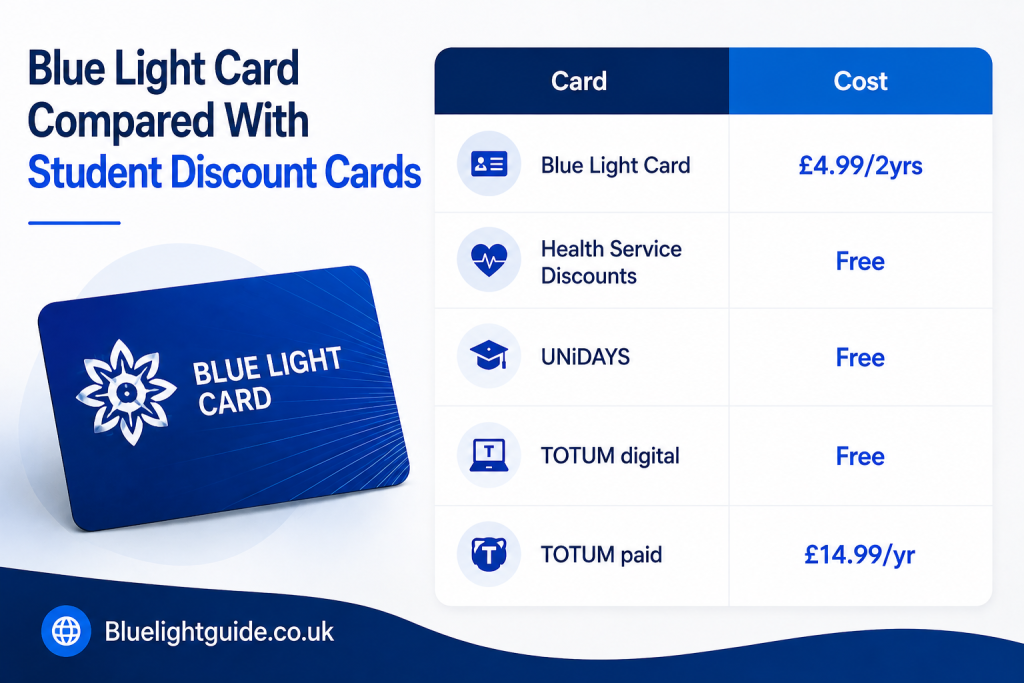
| Card | Cost | Who it accepts |
|---|---|---|
| Blue Light Card | £4.99/2yrs | Placement students only |
| Health Service Discounts | Free | NHS students and staff |
| UNiDAYS | Free | Any enrolled student |
| TOTUM digital | Free | Any enrolled student |
| TOTUM paid | £14.99/yr | Any enrolled student |
Blue Light Card is the only one on that list you cannot get on the strength of being a student, and it is also the cheapest paid option by a distance.
The overlap is smaller than you would expect. Student cards concentrate on fashion, tech and food delivery, while Blue Light Card leans towards theme parks, restaurants and holidays.
TOTUM’s paid tiers are the only ones worth thinking hard about, and they earn their fee through the proof of age ID and international travel card rather than the discounts.
What I Would Do on a Student Budget
Hold three cards and pay for one. UNiDAYS and Health Service Discounts cost nothing, and Blue Light Card at £4.99 for two years works out at roughly twenty pence a month.
Skip the paid TOTUM tiers unless you want the ID card or you are travelling abroad. The discount overlap with the free options does not justify £14.99 a year on a bursary.
Treat the headline savings figures on all of these with suspicion. Blue Light Card advertises an average of over three thousand pounds a year, and its own footnote reveals that is modelled on the top ten percent of offers applied to an average member’s disposable income, which is not a student’s.
Where it pays for itself quickly is a single theme park trip or one Odeon booking, and the fuller picture of what the membership costs and returns is worth a look before you commit even a fiver.
One last thing worth planning for. Your eligibility does not lapse when you graduate into an NHS post, so the card you buy on placement carries straight into your first job and the benefits that come with NHS employment.