
The Blue Light Card is a discount card for people who work on the UK’s frontline, or used to. That covers the NHS, the emergency services, social care, teaching and the armed forces.
Blue Light Guide is an independent guide and isn’t affiliated with Blue Light Card Ltd. For your account, verification or payments, use the official Blue Light Card website or app.
Membership costs £4.99 for two years. In return you get discounts at thousands of brands, online, in shops and through the app.
It isn’t an NHS or government scheme. A private company has run it since 2008, and you apply and pay for it yourself.
Discounts at 15,000 Brands
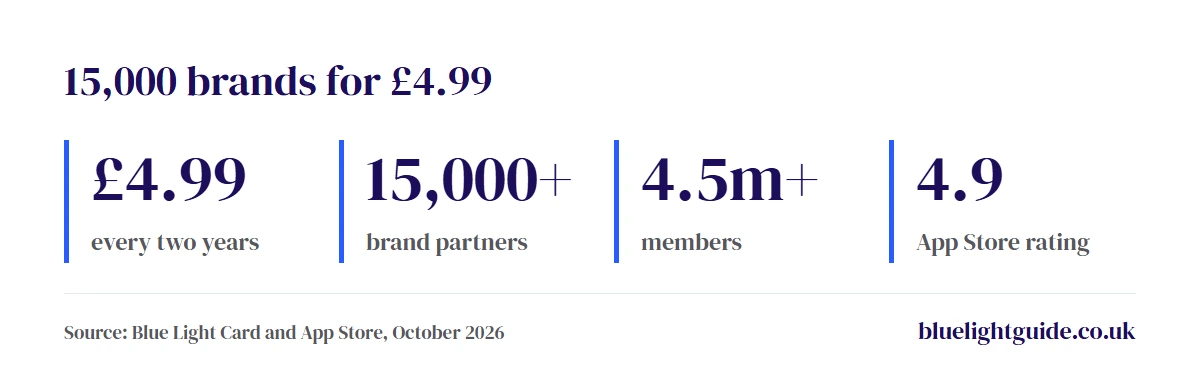
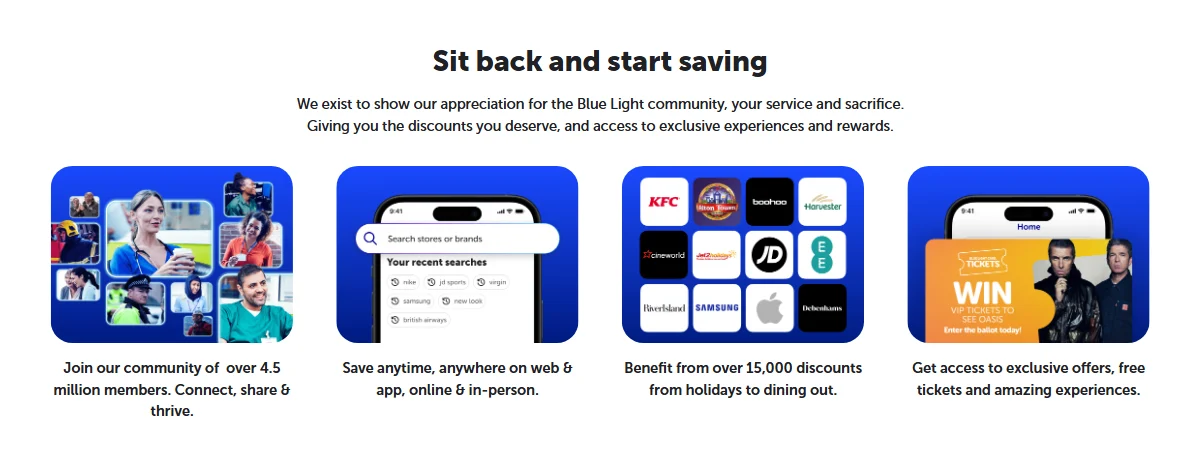
The card is only as useful as its partner list, and that list is long. Blue Light Card says it works with over 15,000 brands, from supermarkets and coffee chains to holidays, tech and car insurance.
The discounts reach you in four main ways.
- Online codes and links. You copy a code from the app or click through from it, and the price drops at checkout.
- In-store offers. You show the virtual card in the app, or the plastic card, at the till.
- Shopping Cards. These are discounted gift cards for more than 100 retailers, explained further down.
- Tickets and Member Days. There are first come, first served tickets, ballots for events, and days when attractions open only for members.
The app is free to download, but the offers only work with a paid membership. Its Near Me feature lists partners close to where you are, which helps when you’re out and want to check a shop before you pay.
Offers rotate often, and the big sales bring extra deals. Blue Light Card’s homepage says this year’s Black Friday offers go live on 27 November 2026.
To see which shops are on the card right now, check our Blue Light Card discounts list by brand.
The Seven Sectors That Qualify
Eligibility depends on your job, not your income. Blue Light Card groups the eligible jobs into seven areas, and almost every one includes people who have retired.
| Sector | Who qualifies |
|---|---|
| NHS and healthcare | NHS, dental, pharmacy and optical staff |
| Emergency services | Ambulance, fire, coastguard and rescue teams |
| Police and justice | Police, prison and probation, Home Office |
| Armed forces | Serving personnel, veterans, MoD staff |
| Education | School staff and Higher Education staff |
| Social care | Care workers and volunteers |
| Search and highways | Search and Rescue, traffic officers |
Two details are easy to miss. Higher Education staff are now on the official list, so university staff should check again even if an older guide said they couldn’t join. And the homelessness workforce is the one group where retired staff aren’t covered.
If you’ve left your job, our guide to the Blue Light Card for retired workers covers the proof you’ll need. Every qualifying role is listed in the full eligibility guide.
Apply in Three Quick Steps
You pick your service, prove where you work, then pay.
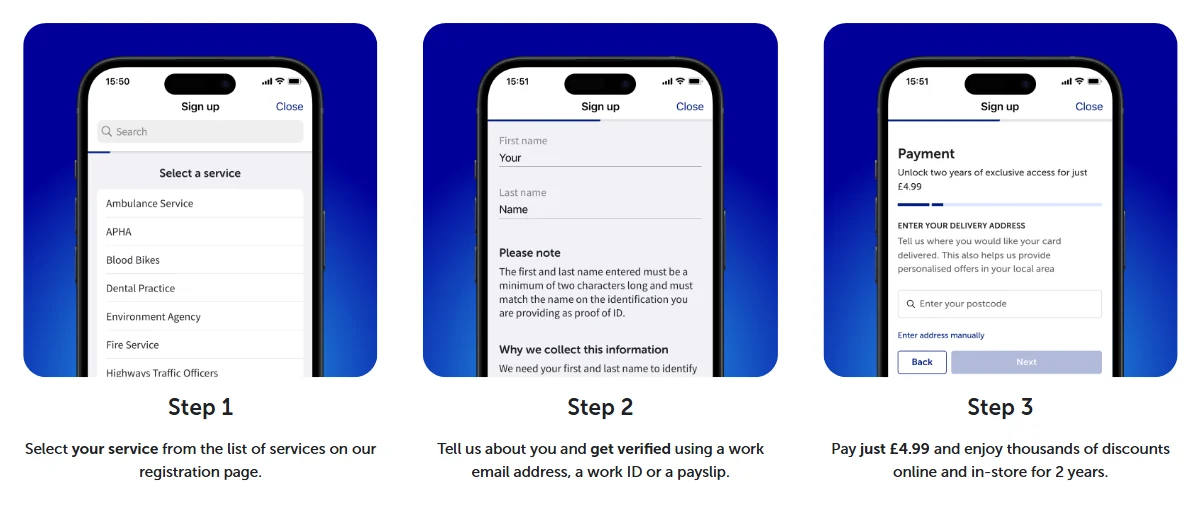
Blue Light Card verifies you with a work email, work ID or payslip. A work email is usually the simplest of the three, because there’s nothing to upload.
After payment, the digital card shows up in the app and a plastic card is posted to the address you give. The application walkthrough covers each screen, including what to do if verification stalls.
Membership lasts two years, and renewing is a manual step. You log in, open Your Card and press Renew, and it costs the same £4.99. Our renewal guide has the details.
Shopping Cards for 100+ Retailers
Shopping Cards are easy to overlook. They’re gift cards sold at a discount, and Blue Light Card offers them for more than 100 retailers, including big supermarkets.

You buy the card in the app, then spend it in store or online like any other gift card. Each retailer sets its own discount, and some get a temporary boost.
The maths is simple. If a card carries a 4% discount, a £100 card costs you £96 and still spends as £100. Used on a weekly food shop, that small cut adds up over a year.
Not every supermarket works the same way, and some won’t take the card at the till at all. Our supermarket comparison shows where a Shopping Card is the only option.
The £3,126 Savings Claim
Blue Light Card’s headline claim is that members could save £3,126 a year. The small print explains where that number comes from.
It uses the top 10% of offers from September 2024 to August 2025, applies an average 22% discount, and sets that against typical household spending. It’s a best case, not a normal year.
A simpler test works better. A 10% discount on a single £50 purchase saves £5, which already covers the fee for two years. If you rarely shop with the big chains, the card will matter less to you.
Health Service Discounts and DDS
Two other schemes overlap with the Blue Light Card, and one of them is free.
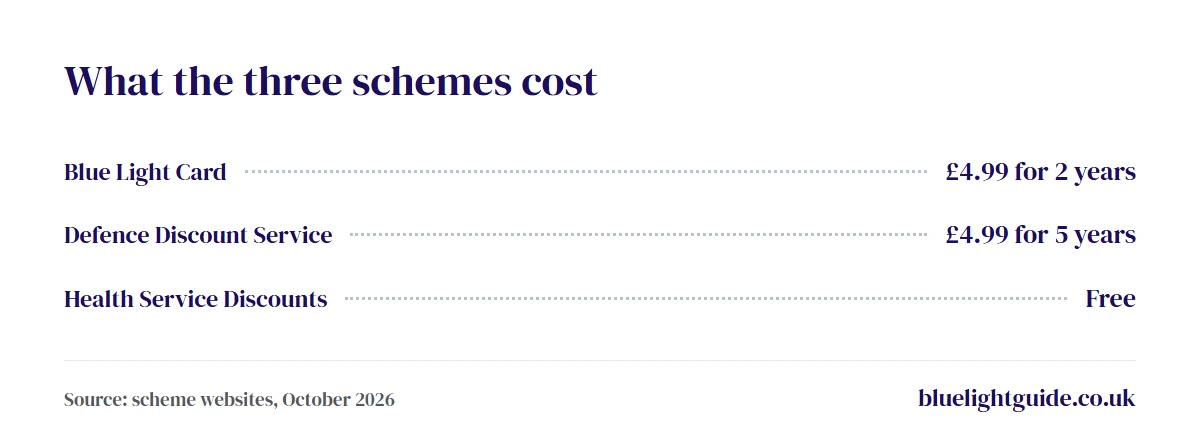
Health Service Discounts is free for healthcare staff, including students and retired staff. Like Blue Light Card, it isn’t run by the NHS, and NHS staff can hold both. Health Service Discounts has its own partner list, so it’s worth comparing the brands you use most.
Defence Discount Service (DDS) is Blue Light Card’s sister brand for the armed forces community. It costs £4.99 for five years, and it also covers spouses and partners of serving personnel, who aren’t on Blue Light Card’s list.
Founded in Loughborough in 2008
Two friends, Tom and Steve, started Blue Light Card in Loughborough in September 2008, according to the company’s own history. The plastic card followed in January 2009, so members could claim discounts at the till for the first time.
The armed forces sister brand, Defence Discount Service, launched in December 2012. Teachers joined the scheme in August 2024, and there’s now a separate version of the card in Australia.
Today the company says it has over 4.5 million members. Its app is rated 4.9 across 542,000 ratings on the App Store.

It’s a private business, not a public service. You pay for the card yourself, and the discounts come from its partner brands. That’s also why offers come and go, so it’s worth checking the app before a big purchase rather than relying on an old screenshot.



Why do merchant seaman not qualify for this card they served ln both wars even though they were not classed as an armed force. A bit biased.
The Blue Light Card eligibility list names the Royal Navy and armed forces veterans but not the Merchant Navy, which is why it doesn’t cover merchant seamen. It’s about which employers Blue Light Card has signed up, not a judgement on the service, and the sacrifice of the Merchant Navy is well recognised.
The Defence Discount Service does accept Merchant Navy veterans who hold the Merchant Navy Veterans Badge, so that card is the better route, and you can also ask Blue Light Card to review the criteria.